Wind Deflectors: How They Work and Are They Worth It?
Crack a window on the motorway and you get a choice: deafening buffeting, or no fresh air at all. Park in the rain with the glass up and the cabin fogs before you reach the shops. Wind deflectors — also sold as window visors, vent shades or rain guards — exist to solve exactly that trade-off. They are one of the cheapest exterior parts you can fit, and one of the most misunderstood.
Here is how they actually work, what they genuinely do for you, and where they fall short.
What Is a Wind Deflector?
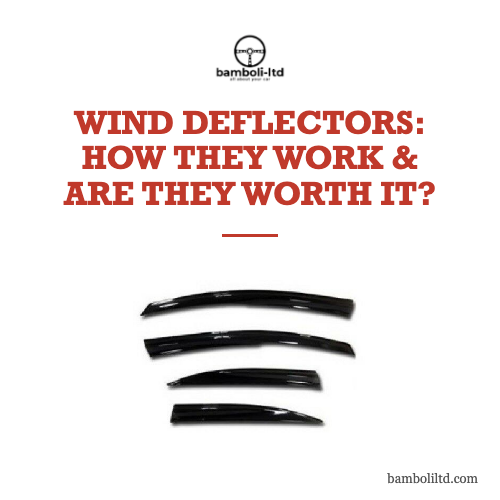
A wind deflector is a moulded strip of acrylic or polycarbonate that mounts along the top edge of a door window. It sits proud of the glass by a couple of centimetres and extends slightly past the window opening.
You will see the same part sold under several names. Window visor, vent shade, rain guard and weather shield all describe the same component. Most sets cover all four doors; two-piece front-only sets are common on vans and pick-ups.

How Wind Deflectors Actually Work
The physics is simpler than it looks. With a window cracked open and no deflector, air hits the opening square-on and tumbles into the cabin. That turbulence is what produces the low-frequency thumping — the effect drivers call wind throb or buffeting.
A deflector sits ahead of and above that gap. Instead of striking the opening directly, air is guided up and over it, and rejoins the airflow past the door. The window opening ends up in a pocket of relatively calm air.
Two useful consequences follow. Rain travelling along the body side is thrown clear of the gap rather than running into it. And because the opening is shielded, you can leave the glass down 2–3 cm while parked without water getting in.
What They Genuinely Do Well
Ventilation in bad weather. The strongest case. Leave the windows cracked in rain and the cabin stays dry while stale air escapes — which matters most on a car that sits outside overnight.
Less fogging. Trapped moisture is what mists your glass on a cold morning. A gap that vents continuously keeps humidity down, so the demister has less work to do.
Reduced buffeting at speed. With a deflector fitted you can usually run the window open further before the throbbing starts.
A cooler cabin when parked. A car left in the sun with sealed windows becomes an oven. A vented gap lets hot air escape, and the smoked tint cuts some of the glare landing on the door card.

Where They Fall Short
Being honest about the limits saves returns.
They add a little drag. The effect on fuel consumption is small — far smaller than a loaded roof rack, as we covered in our piece on roof racks and fuel efficiency — but it is not zero.
Some noise at motorway speed. With the windows fully closed, a deflector can introduce a faint whistle where there was none. Fit quality is usually the culprit.
Automatic car washes. Tape-mounted deflectors and spinning brushes are not natural allies. Most survive fine; a poorly bonded one may not.
The look is not universal. Smoked acrylic suits modern hatchbacks and SUVs. On a concours classic it can look out of place.
Tape-On or In-Channel?
Two mounting styles dominate, and the choice matters more than the brand.
Tape-on (stick-on) deflectors bond to the outside of the door frame with automotive double-sided tape. They fit almost any car, sit slightly further from the glass, and are the common choice for classics where the window channel is old or irregular. Surface preparation is everything — clean the frame with isopropyl alcohol, fit above 15 °C, and leave the doors shut for 24 hours.
In-channel deflectors slot into the window run channel itself. The result is flush and factory-looking, with nothing bonded to the paint. The trade-off is that they are strictly vehicle-specific, and on some cars they can interfere with auto-up window sensors.
Fitment Is Not Optional
A deflector is shaped to one door frame profile. A set cut for a saloon will not follow the curve of the same model's estate or hatchback, and a pre-facelift frame is often a different shape from the facelift.
Check three things before ordering: exact body style, production years, and piece count. A "4 Pcs" set covers front and rear doors; a 2-piece set covers the fronts only. Getting this wrong is the single most common reason these parts get sent back.
So — Are They Worth It?
Yes, if your car lives outdoors, you drive in a wet or humid climate, you smoke or carry pets, or motorway wind noise with a cracked window already annoys you. For the price of a tank of fuel, the daily-use improvement is real.
Probably not, if the car is garaged, you almost always drive with windows up and climate control on, or you are restoring a classic to original specification.
Frequently Asked Questions
Do wind deflectors affect fuel economy?
Marginally. They add a small frontal area, but the effect is measured in fractions of a litre per 100 km — far less than roof-mounted cargo. Any loss is usually offset by needing air conditioning less often.
Can I go through an automatic car wash with them fitted?
Generally yes, provided a tape-on set has fully cured for at least 24–48 hours. Touchless washes are the safer choice for older bonded deflectors.
Are they legal?
In most countries yes, as long as they do not obstruct the driver's view. Rules on tint darkness for front side windows vary, so check local regulations if you want a heavily smoked set.
Will one set fit several cars?
No. Deflectors follow the door frame profile of one specific model, body style and year range. "Universal" strips exist but rarely sit flush.
How do I remove them without damaging the paint?
Warm the tape gently with a hairdryer, work fishing line behind the deflector to cut the adhesive, then lift residue with an adhesive remover on a microfibre cloth. Never prise with a metal tool.
Find the Right Deflectors for Your Car
We stock smoked window visor sets alongside the wider sun visor range in our Deflector & Sun Visors collection, with model-specific fitment from modern hatchbacks to vans. If you are working on a classic instead, the American Sun Visor range covers factory-style interior visor replacements — a different part solving a different problem, aimed at restoring worn, sagging originals rather than adding ventilation.
Not sure which body style you have, or whether a set covers two doors or four? Send us the model, year and body style and we will confirm the correct fitment before you order.
-
Posted in
Rain Guard, Sun Visor, Wind Deflector, Window Visor