Mercedes W124 Buyer's Guide: What to Check Before You Buy
The W124 has a reputation that gets repeated so often it has almost stopped meaning anything: the last over-engineered Mercedes. What that actually translates to on a car that is now thirty to forty years old is more specific — a shell and a drivetrain that will still be sound if the car was looked after, and a short, well-documented list of things that go wrong if it was not.
This guide covers what to check before you buy one, which faults are cheap and which are not, and what you can realistically still get parts for.
What the W124 Actually Is — and Why the Name Confuses People
The 124 series was presented in late 1984 and built as a saloon from January 1985 to August 1995. For most of that run it was not called the E-Class at all. Cars were badged by engine — 200E, 230E, 300E, 250D — and it was only with the second facelift in August 1993 that Mercedes officially marketed the range as the E-Class. So a 1988 300E and a 1994 E320 are the same car family under two naming systems.
This causes a common mix-up worth clearing up, because it sends people to the wrong parts. The W201 — the smaller 190, 190E and 190D, the "Baby Benz" — is not an E-Class. The E in 190E stands for Einspritzung, German for fuel injection, exactly as the D in 190D stands for diesel. It is an engine designation, not a class name. The W201's successor was the C-Class. If you are shopping for interior or trim parts, W124 and W201 are different cars with different part numbers, even where the styling looks close.

The Body Styles
Saloon (W124) — January 1985 to August 1995. The common one, and the easiest to find parts for.
Estate (S124) — October 1985 to February 1996. Self-levelling rear suspension is standard; check it works before you fall in love with the load space.
Coupé (C124) — April 1987 to March 1996. Pillarless. Window and door seals are specific to the coupé and not interchangeable with the saloon.
Cabriolet (A124) — March 1992 to July 1997. The rarest and the most expensive to put right, because the roof mechanism and its hydraulics are on top of everything else in this guide.
Rust: Look Here First
Rust is what decides whether a W124 is a good buy or a money pit. Everything else on this list is a repair; serious structural rust is a project. Check, in this order:
Jack points and sills. Press them. Soft or crunchy means the repair is already overdue.
Front spring perches. A known weak spot and awkward to fix properly.
Wheel arches, front and rear, including the lip you only see with the wheel turned.
Boot floor and spare wheel well. Lift the mat and the spare. Water collects here when seals or lamp gaskets fail.
Floor pans and door bottoms, along the seams.
Windscreen and rear screen surrounds. Rust under the glass rubber is expensive because the glass has to come out.
Most of these start the same way — a tired rubber seal lets water sit somewhere it should drain. Replacing a door and trunk weatherstrip set is cheap next to bodywork, which is why it is worth doing as soon as you buy the car rather than after the first wet winter.

Engines: What Each One Asks of You
The range covered four-cylinder petrol (M102, later M111), six-cylinder petrol (M103, M104), V8 (M119) and a long line of diesels (OM601, OM602, OM603, OM605, OM606).
Head gaskets on the six-cylinder M103 and M104 are the fault to look for. Symptoms are oil weeping down the block, coolant that looks foamy or milky, and a car that quietly drinks water. Check the expansion tank and the oil filler cap before you drive it, not after.
Diesels are the durability champions of the range and the reason so many W124s passed 300,000 miles. They are not immune — check for smoke, and listen for injector noise — but a well-kept OM60x is the lowest-drama choice here.
The V8 cars (500E/E500) are a different proposition entirely, built in collaboration with Porsche and priced accordingly, both to buy and to maintain.
The 1992–1996 Wiring Harness
This one catches people out because the car can look immaculate. On cars built roughly between 1992 and 1996, Mercedes used a biodegradable insulation on the engine wiring harness. It was an early environmental measure and it worked rather too well: under engine-bay heat the insulation goes brittle, cracks and flakes off, leaving bare wire.
The symptoms are electrical and inconsistent — rough running, warning lights that come and go, faults that chase their own tail. Open the bonnet and physically look at the loom. If the insulation is cracking or crumbling where you flex it, budget for a harness replacement and price that in before you agree anything.
The Sunroof
A W124 sunroof that has been left alone for twenty years usually needs the same two things: fresh sliding seals, and the lifter mechanism repaired. The failure mode people notice first is water — a sunroof whose drains are blocked or whose seal has hardened will put water into the headliner and, eventually, into the floor.
Both are addressable without specialist tooling. A sunroof repair kit covers the mechanism, and the sliding seal is available separately. If the car you are looking at has damp headlining, this is usually the cause rather than something worse.
Inside the Car: What Wears, and What You Can Replace
The W124 interior wears in predictable places, and this is the good news of the whole guide — almost all of it is replaceable without hunting scrapyards.
Steering wheel. The most-noticed worn part in the cabin. Original wheels go shiny and the rim finish breaks down. Remanufactured wood-rim steering wheels in zebrano and walnut are made for the W124, and several fit the W123, W126 and W201 as well.
Wood trim. Door trims, the climate panel, the console and the speedometer surround all lacquer-crack under sunlight. These are sold individually and as sets, so you can do the console now and the doors later.
Shift knob. Cheap, quick, and it changes how the car feels every time you drive it. Automatic and manual knobs are available in zebrano and walnut.
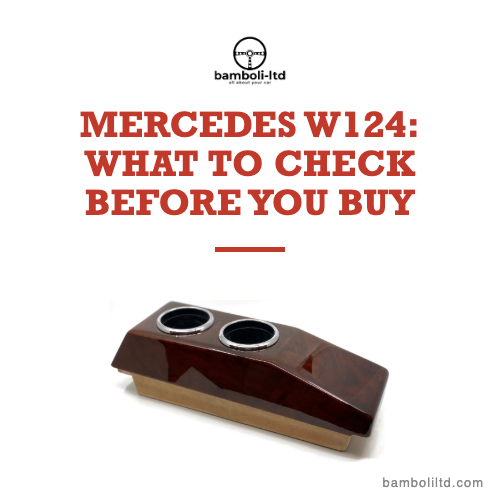
Cup holder. The factory centre-console holder is famously fragile — the mechanism breaks and the wood cracks. Replacements exist in walnut and zebrano, and there is a plain black leather version if you would rather not match wood.

A Pre-Purchase Checklist
Before you drive it: press the jack points; lift the boot mat and the spare; look under the glass rubbers; open the bonnet and flex the wiring insulation; check the coolant tank and oil cap; push the headlining around the sunroof for damp.
While you drive it: listen for the self-levelling on an estate; watch the temperature gauge; try every electrical switch, twice.
After you drive it: look under where it was parked. Then price the seals, the harness if needed, and the interior parts you already know you want — that total, not the asking price, is what the car costs you.
Frequently Asked Questions
Is the W124 the E-Class?
Yes, from August 1993. Before that the same cars were badged by engine — 200E, 300E, 250D and so on. The E-Class name was applied to the 124 series at the second facelift, so early and late cars are the same family under different naming.
Is the 190E a small E-Class?
No. The 190, 190E and 190D are the W201, a separate and smaller model whose successor was the C-Class. The E in 190E means Einspritzung — fuel injection — not E-Class. W124 and W201 parts are not interchangeable as a rule.
Which W124 engine is the most reliable?
The diesels, by reputation and by service history. Among the petrols, the six-cylinder M103 and M104 are strong engines with one specific weakness to check for — the head gasket.
What is the biodegradable wiring harness problem?
On cars built around 1992 to 1996, the engine harness insulation degrades with heat, cracks and exposes the wire. It causes intermittent electrical faults. Inspect the loom by eye and by flexing it; replacement is the fix.
Are W124 parts still available?
Interior, trim and rubber parts are widely available, including remanufactured wood steering wheels, wood trim sets, seals and sunroof components. Model-specific body parts for the coupé and cabriolet are harder to source than saloon equivalents.
Do coupé parts fit the saloon?
Often not. The C124 is pillarless, so window and door seals in particular are specific to it. Check the body style as well as the year range before ordering.
Where to Start
If you have just bought one, the sensible order is seals first, then whatever is letting water in, then the interior. Everything in this guide is gathered in our Mercedes W124 Parts collection — seals, wood trim, steering wheels, cup holders, shift knobs, sunroof parts and mouldings for the saloon, estate and coupé.
For the wider range, Classic Mercedes Parts covers the W123, W126 and R107 as well, and the Steering Wheels collection carries the remanufactured wood-rim wheels on their own.
For a wider view of the classic Mercedes range, see our Classic Mercedes Parts Guide, or the W123 Interior Restoration Checklist if the car you are looking at is the generation before.
Not sure whether a part is right for your body style or year? Send us the model, year and body style and we will confirm fitment before you order.